
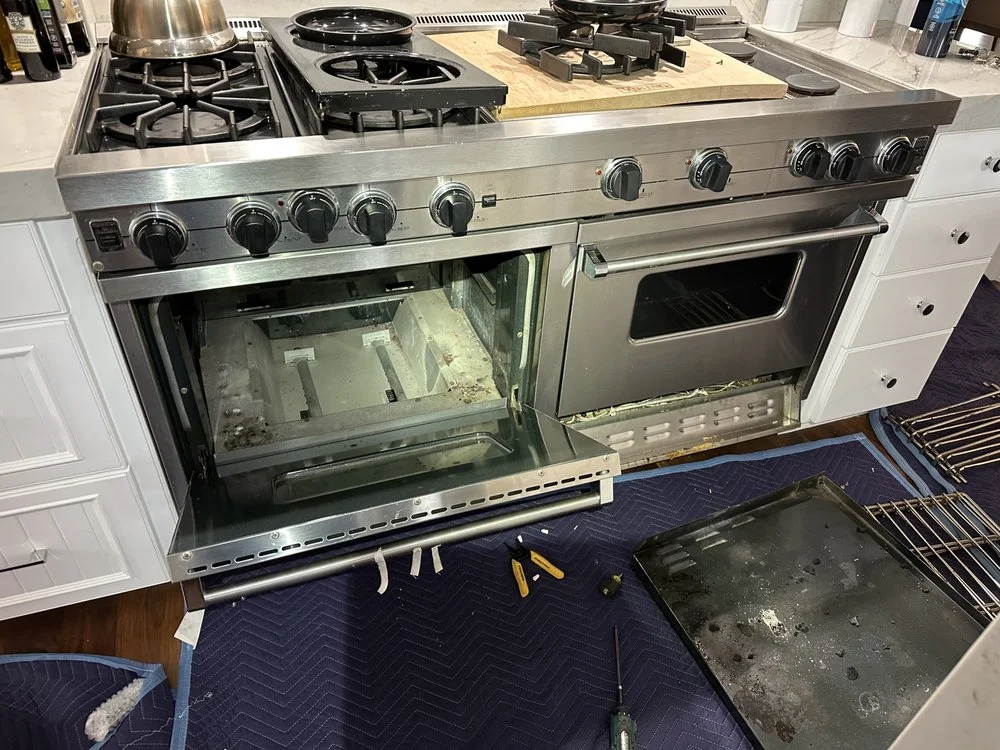
A Wolf range is engineered for precision temperature control, whether you are using a Dual Fuel, All-Gas (GR/R Series), or Induction setup. When cookies bake darker on one side, roast meat takes hours longer than expected, or your gas surface burners produce lopsided flames, the culprits are usually specific mechanical or electronic component failures.
If your Wolf range is not heating evenly, the issue typically stems from a weakened igniter (gas models), a single failed dual-convection fan, a drifted Platinum RTD temperature sensor, or a damaged door gasket. While user error (such as skipping preheat or improper rack positioning) accounts for minor variations, persistent uneven heat points directly to hardware degradation.
Below is a diagnostic roadmap to pinpoint exactly why your Wolf oven, surface burners, or griddle top are misbehaving—along with practical steps to restore factory-level performance.
Quick Diagnostic: Identifying Uneven Heating Patterns
Before tearing into your range, narrow down the symptoms to the exact subsystem experiencing thermal imbalance.
| Symptom | Affected Component | Likely Root Cause |
| Front of baking sheet undercooked, back burned | Oven Door Gasket / Hinge | Degraded silicone rubber seal letting cold air pull into the front |
| Left side of cavity cooks fast, right side stays cold | Convection Fan Motor | Single fan failure in a dual-convection setup |
| Gas oven takes 30+ minutes to reach 350°F | Gas Igniter (Silicon Carbide) | Igniter resistance high; failing to draw ~3.2–3.6 amps to open safety valve |
| Oven consistently runs 35°F–50°F too hot or cold | Platinum RTD Temperature Sensor | Sensor resistance drifted outside standard 1,080–1,100 $\Omega$ range at room temperature |
| Cooktop burner flame is yellow, weak, or lopsided | Burner Cap / Igniter / Gas Valve | Clogged burner ports, low gas pressure, or misaligned cap |
| Integrated griddle burns food near the back vent | Normal Airflow / Griddle Thermostat | Back-vent heat accumulation or a failing griddle thermostat probe |
5 Common Reasons Your Wolf Oven Cavity Is Heating Unevenly
1. Weakened Gas Bake Igniter (Gas & Dual Fuel Models)
In Wolf gas ovens, the igniter serves a dual purpose: it glows white-hot to ignite the gas and draws enough electrical current to open the gas safety valve.
- The Problem: Igniters weaken over time rather than failing instantly. A weak igniter will still glow red, but it may fail to reach the threshold current (typically 3.2 to 3.6 amps) needed to keep the gas valve fully open. This causes the flame to cycle off prematurely, dropping overall temperature and causing cold spots.
- The Fix: Disconnect power, remove the bottom oven panel, and inspect the igniter during a bake cycle. If it takes longer than 90 seconds to light the gas burner or glows dull orange instead of brilliant white-hot, it requires replacement.
2. Failure of One Dual-Convection Fan
Most 30″, 36″, and 48″ Wolf ranges feature a dual-convection system with two fans pushing heat evenly across the cavity.
- The Problem: If one convection fan motor burns out or suffers worn bearings, the remaining fan continues to circulate air on its side. This creates a severe temperature gradient: hot, circulating air on one side, and stagnant, underheated air on the other.
- The Fix: Turn on Convection Bake mode while the oven is empty. Listen for fan hum on both sides, or use a flashlight to look through the rear baffle panel vents to confirm both impellers are spinning freely. If one fan is silent or grinding, the motor assembly needs to be serviced.
3. Platinum RTD Temperature Sensor Drift
Wolf ovens rely on a Resistance Temperature Detector (RTD) probe to monitor cavity temperatures.
- The Problem: At a room temperature of 70°F (21°C), a functional Wolf platinum RTD probe should read approximately $1080\,\Omega$ to $1100\,\Omega$ of electrical resistance. Over time, thermal stress causes the internal platinum element to drift. If the probe reads $1180\,\Omega$ at room temperature, the control board assumes the oven is already warmer than it actually is, causing it to cycle off early.
- The Fix: Test the probe using a multimeter set to measure resistance ($\Omega$). Unplug the probe from its wiring harness inside the cavity and check the terminal pins. If the resistance deviates significantly from $1080\,\Omega$–$1100\,\Omega$ at 70°F, recalibrating the oven settings won’t solve the issue—the RTD probe must be replaced.
→ > 1130 Ohms: Oven runs excessively COLD
→ Infinite / Open: Sensor wire fractured — Replace Sensor
4. Degraded Door Gasket or Worn Hinges
Even small leaks around the oven door seal allow ambient room air to enter, chilling the front portion of your baking sheets.
- The Problem: High-heat self-cleaning cycles, grease accumulation, and age cause the woven fiberglass or silicone door gasket to harden, crack, or flatten. Additionally, tired door hinges can prevent the door from sealing tightly against the front frame.
- The Fix: Inspect the seal along the top, sides, and bottom perimeter. Perform the “dollar bill test”: insert a dollar bill between the door gasket and the oven frame, close the door, and pull. If the bill slips out with zero resistance, replace the gasket or adjust the door hinge receivers.
5. Control Board Offset knocked off by Power Outages
Following power outages or electrical surges, the wolf microwave-controller on your Wolf range’s main circuit board can experience memory corruption, skewing the internal calibration offset.
- The Fix:Wolf allows users to adjust the oven calibration offset by up to $\pm 35^\circ\text{F}$ via the control settings.
- Place an accurate oven thermometer on the center rack.
- Set the oven to 350°F on standard Bake mode and let it complete a 20-minute preheat.
- If the thermometer reads consistently off by 15°F–30°F across multiple heating cycles, adjust the calibration offset in your user menu.
- Note: If the temp difference exceeds 35°F, do not rely on calibration offset—this indicates a defective RTD sensor or control board failure.
Troubleshooting Wolf Gas Cooktops and Surface Griddles
Uneven cooking isn’t limited to the oven cavity. If your wolf cooktop surface gas burners or built-in French tops/griddles are cooking unevenly, review these causes:
Clogged Burner Port Ring Slits
Spills from boiled pots can deposit grease and mineral scale into the brass burner ports. Clean the ports using a wooden toothpick or a soft bristle brush. Avoid metal paperclips or drill bits, which can enlarge the precision orifices and disrupt gas velocity.
Griddle Vent Thermal Accumulation
Wolf griddles are engineered with a slight natural temperature variance: the rear of the griddle runs naturally warmer than the front because heat drains toward the back vent trim.However, if half the griddle plate remains completely cold while the other side functions, the issue is typically a failed griddle thermostat, loose thermal coupling, or a blown spark module on gas models.
DIY Fixes vs. Professional Repair
While simple adjustments can be handled safely at home, complex electrical and gas line diagnostics require factory-trained service.
DIY Friendly Checklist:
 [1] Clean burner caps and gas ports with warm water & dish soap.
 [2] Perform dollar-bill seal check on oven door gasket.
 [3] Verify correct rack placement (Level 3 for single-rack baking).
 [4] Verify full preheat tone before placing food in cavity.

Requires Certified Technician:
 [1] Multimeter testing of live 240V dual-convection fan motors.
 [2] Replacing hardwired platinum RTD probes.
 [3] Gas valve manifold pressure adjustments using a manometer.
 [4] Tripped thermal fuse replacement after a self-clean cycle.
If your appliance requires technical inspection, component replacements, or electrical diagnostics, booking a factory-certified technician ensures your range maintains its performance and safety standards. Learn more about certified repair options by visiting Davis Sub-Zero Repair.
Restore Precision Cooking to Your Kitchen
Troubleshooting a luxury appliance like a Wolf range requires precise diagnostics. Whether you are dealing with a failing dual-convection fan, a drifted RTD sensor, or a sluggish igniter, guessing at complex electrical and gas repairs can lead to extended downtime and safety risks.
If you prefer expert assistance to restore your range to factory-level performance, our factory-trained technicians are ready to help. Explore our specialized Wolf Appliance Repair Services, check out our local coverage on our Los Angeles Service Team page, or schedule an inspection directly with Davis Sub-Zero Repair.
Frequently Asked Questions
Why is my Wolf oven burning food on one side?
This is almost always caused by a failed convection fan motor on dual-convection models.When one fan stops working while the other continues spinning, hot air circulates unevenly across the baking cavity, causing food closer to the active fan to cook faster.
How do I calibrate the temperature on a Wolf range?
You can adjust the temperature offset via the oven control panel by holding the Bake button (or entering settings depending on your model series) and entering an offset of up to $\pm 35^\circ\text{F}$.If your temperature is off by more than 35°F, the RTD temperature probe has likely drifted out of spec and requires replacement.
Why does my gas Wolf oven take so long to preheat?
A prolonged preheat phase usually indicates a failing silicon carbide igniter.As igniters age, their internal resistance increases, reducing the electrical current sent to the safety valve.This causes the valve to open slowly or cycle off early, reducing total heat output.
Is it normal for a Wolf griddle to be hotter in the back?
Yes, Wolf griddles are designed to vent heat toward the back of the rangetop, making the rear section slightly warmer than the front during normal operation.However, distinct left-to-right temperature drops indicate a faulty griddle thermostat or heating element issue.
Can a self-clean cycle cause uneven heating in a Wolf range?
Yes.The extreme heat of a self-clean cycle can weaken already aging components, trip high-limit thermal fuses, or damage the RTD temperature sensor.If your oven stops heating evenly immediately after running self-clean, a thermal cut-out or sensor probe has likely failed.