
When your Sub-Zero stops keeping food cold, the compressor is often the first thing people worry about, and for good reason. It is the heart of the cooling system, and it is the part that costs the most to fix. The good news is that many Sub-Zero compressor problems turn out to be smaller electrical issues, and catching them early can save you a lot of money and a refrigerator full of spoiled food.
This guide covers the warning signs, the most common causes, what you can safely check yourself, and what repairs usually cost.
Quick answer: If your Sub-Zero is warm inside but you can hear the compressor clicking, humming loudly, running nonstop or not running at all, turn the unit’s settings and power connection into your first check, then call a professional. Do not try to open or repair the sealed cooling system yourself.
What the Compressor Does in Your Sub-Zero
The compressor pumps refrigerant through the sealed system. That circulation is what pulls heat out of the refrigerator and freezer compartments. When the compressor struggles or stops, the rest of the system can keep running (lights, fans, display) while the temperature slowly climbs.
Some Sub-Zero models use separate sealed systems for the refrigerator and freezer sides, so one section can warm up while the other stays cold. That pattern can help point a technician in the right direction.
Signs of Sub-Zero Compressor Problems
Watch for these symptoms. Any one of them is worth taking seriously, especially if more than one shows up together.
The unit is warm, but the lights and fans work
If the display and interior lights are fine but the compartments are no longer cold, the cooling system is not doing its job. This is the most common sign people notice first.
The compressor runs constantly, or never runs
A compressor that runs nonstop without reaching the set temperature is working too hard. One that never starts at all means the system is not circulating refrigerant. Both need diagnosis.
Clicking, buzzing or unusually loud noises
A single soft click when the compressor starts is normal. Repeated clicking, a harsh buzz or a new loud grinding or rattling sound is not. Repeated clicking often points to a start relay or capacitor problem rather than the compressor itself.
Frost, ice or condensation in new places
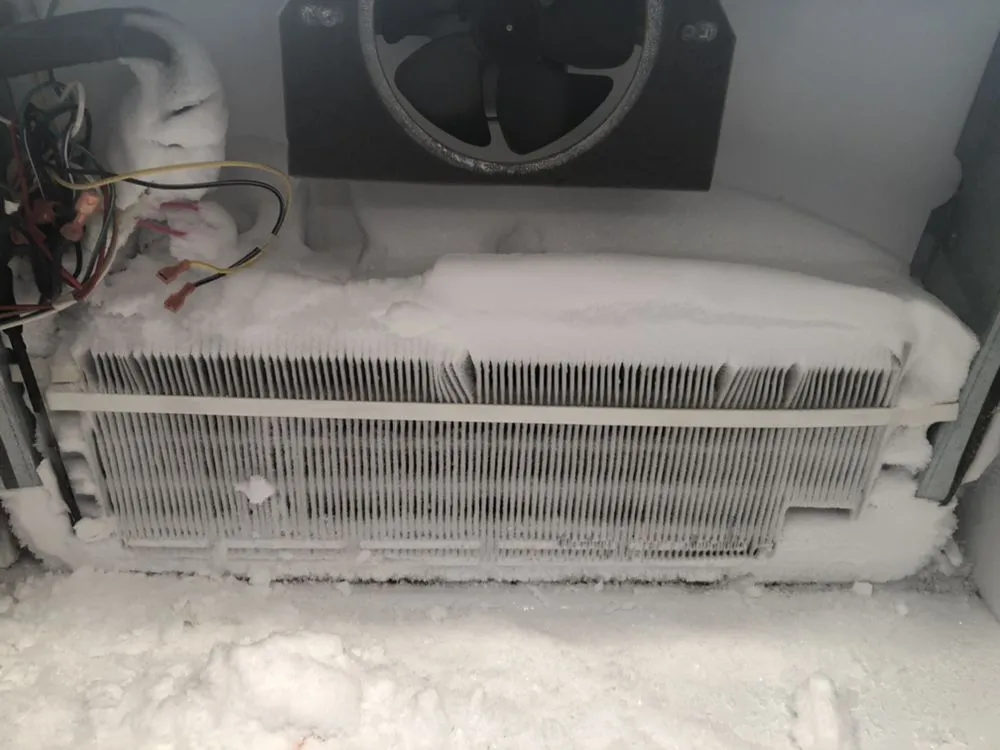
Heavy frost or unexpected moisture can mean the system is not cooling evenly.
Tripped breakers or flickering power
If the refrigerator trips the breaker when the compressor tries to start, stop using it and call for service. Do not keep resetting the breaker.
Common Causes of Compressor Trouble
Not every cooling problem is a failed compressor. A proper diagnosis matters, because the cause decides the repair and the cost.
- Dirty condenser coils or blocked airflow: Dust and debris make the system run hotter and longer, which wears the compressor faster.
- Failed start relay or capacitor: These electrical parts help the compressor start. When they fail, the compressor may click and shut off, even though the compressor itself is fine.
- Control board or sensor faults: A bad sensor or board can stop the compressor from getting the signal to run, which looks like compressor failure from the outside.
- Refrigerant leaks: A leak lowers cooling power and forces the system to work harder.
- Age, wear and power surges: Over many years of use, compressors wear out. Voltage spikes can also damage the electrical components around them.
Symptoms at a glance
| Symptom | Likely cause | Compressor itself? | How urgent |
| Warm inside, but lights and fans work | Cooling system not working: compressor, sealed system or controls | Possible | Call today |
| Repeated clicking, then silence | Start relay or capacitor | Often not | Call soon |
| Runs nonstop and never reaches temperature | Dirty coils, blocked airflow, refrigerant leak or a worn compressor | Possible | Call soon |
| Never starts | Control board, sensor, start components or compressor | Possible | Call today |
| Heavy frost or moisture in new places | Uneven cooling or a door seal leak | Less likely | Schedule a check |
| Trips the breaker at startup | Electrical fault or a failing compressor | Possible | Stop using it and call now |
What You Can Safely Check Yourself
These checks are low-risk and sometimes solve the problem. Always unplug the refrigerator or switch off its power before cleaning anything.
- Confirm power and settings. Make sure the unit is on, the breaker has not tripped, and the temperature is set where you expect. Check that the unit was not switched to a demo or off mode.
- Check airflow around the unit. Make sure nothing is blocking the grille or ventilation area, and that stored items are not pressed against the vents inside.
- Clean the grille and condenser area. With the power off, gently vacuum dust from the grille and the accessible condenser area. Dirty coils are one of the most common causes of overheating.
- Inspect the door seals. Warm air leaking in makes the system run longer. Look for gaps, tears or doors that do not close fully.
- Write down what you notice. Note the model and serial number, what sounds you hear, and which compartment is warm. This helps the technician diagnose faster.
Do not try to open the sealed system, handle refrigerant, or work on electrical components inside the compressor compartment. This work needs proper tools, training and safe handling.
Who should handle what
| Task | Safe to DIY? | Notes |
| Check power, breaker and temperature setting | Yes | Confirm the unit is on and not in a demo or off mode |
| Check airflow around the grille and vents | Yes | Keep stored items away from the vents |
| Vacuum the grille and accessible condenser area | Yes, with power off | Unplug or switch off the unit first |
| Inspect door seals | Yes | Look for gaps, tears or doors that do not close fully |
| Test or replace a start relay or capacitor | No | Electrical work inside the compressor compartment |
| Handle refrigerant or open the sealed system | No | Needs proper tools, training and safe handling |
| Keep resetting a tripping breaker | No | Stop using the unit and call for service |
When to Call a Professional
Call for service if:
- The unit is warm and the basic checks above did not help
- The compressor is clicking repeatedly, buzzing, or running nonstop
- The breaker trips when the refrigerator starts
- You notice an unusual smell, burning odor or visible oil near the compressor
- Food has been above safe temperatures for an extended time
Compressors are part of a sealed system, so correct diagnosis comes before any repair. At Davis Sub-Zero Appliance Repair, our technicians test the electrical components, check airflow and sensors, and confirm whether the sealed system is the real problem before recommending a repair. Learn more about our Sub-Zero refrigerator repair service in Orange County.
How Compressor Repairs Work
A good repair follows a sensible order:
- Diagnosis: The technician checks power, temperatures, sensors, the control board, the start components and the airflow before blaming the compressor.
- Electrical component repair: If the start relay or capacitor has failed, replacing it is often the simplest and least expensive fix.
- Sealed system repair: If the problem is in the sealed system itself, such as a leak or a failed compressor, the repair is more involved and requires safe refrigerant handling.
- Testing: After the repair, the unit is monitored to confirm it holds temperature and cycles normally.
Cost of Sub-Zero Compressor Problems
Cost depends on what is actually wrong, your model, and how accessible the part is. As a general guide, not a quote:
| Repair | What it involves | Typical cost level | Repair or replace the unit? |
| Start relay or capacitor | Replacing the electrical part that helps the compressor start | Lower end, often a few hundred dollars including labor | Repair usually makes sense |
| Sensor or control board | Replacing the faulty part so the compressor gets its signal | Middle of the range, depending on the part | Repair usually makes sense |
| Sealed system or full compressor replacement | Fixing a leak or replacing a failed compressor, with safe refrigerant handling | Highest, and can run well over a thousand dollars on a premium unit | Depends on age, repair history and the estimate |
Because Sub-Zero parts are premium parts, costs run higher than they do for a typical refrigerator. We give you an upfront estimate before any work starts, with no hidden fees.
Repair or Replace?
Sub-Zero refrigerators are built to last, and in many cases repairing one costs far less than buying a new premium unit. Repair usually makes sense when the problem is an electrical part, a sensor, or a single failed component and the rest of the unit is in good shape.
Replacement deserves a conversation when the unit is very old, has had repeated sealed-system failures, or the repair estimate is close to the value of the appliance. We tell you honestly which way makes sense, so you are not paying for a repair that will not hold.
Repair or replace at a glance
| Factor | Repair usually makes sense | Replacement deserves a conversation |
| Cause | An electrical part, a sensor or a single failed component | Repeated sealed-system failures |
| Unit age | A newer unit in good shape | A very old unit |
| Estimate vs. value | Well below the value of the appliance | Close to the value of the appliance |
How to Prevent Compressor Problems
- Clean the grille and condenser area a couple of times a year
- Leave breathing room around the unit for airflow
- Keep door seals clean and check that doors close fully
- Use a quality surge protector or whole-house protection if your power is unstable
- Do not ignore early noises or temperature swings
FAQ
How do I know if my Sub-Zero compressor is failing?
The most common signs are a warm refrigerator or freezer with the lights still on, repeated clicking, loud buzzing, constant running, or a tripped breaker. Because a relay, sensor or control board can cause similar symptoms, a technician should confirm the diagnosis before you assume the compressor is dead.
Can a Sub-Zero compressor be repaired, or does it need replacing?
It depends on the cause. Many problems that look like compressor failure are actually start components or controls, which are repairable. If the compressor or sealed system has failed, replacement is possible, and we can walk you through your options.
Is it worth repairing a Sub-Zero compressor?
Often yes, especially for newer units or when the problem is an electrical part. Premium Sub-Zero units are expensive to replace, so repair frequently makes better financial sense. We will give you an honest recommendation after the diagnosis.
How long can food stay safe if my Sub-Zero stops cooling?
Keep doors closed as much as possible. Perishable food that has been above safe temperatures for an extended period should be checked carefully, and when in doubt, throw it out. Call us quickly so the cooling problem does not cost you more food.
Do you offer same-day repair for Sub-Zero compressor problems in Orange County?
Yes. We offer same-day and next-day appointments across Orange County, and most repairs are completed on the first visit.
Get Your Sub-Zero Cooling Again
If you are dealing with Sub-Zero compressor problems, do not wait for the unit to fail completely. Call (657) 333-5237 or book online. We are available Monday through Saturday, 7:00 AM to 8:00 PM, with same-day appointments, upfront pricing and a 1-year parts and labor warranty. See the areas we serve across Orange County.