
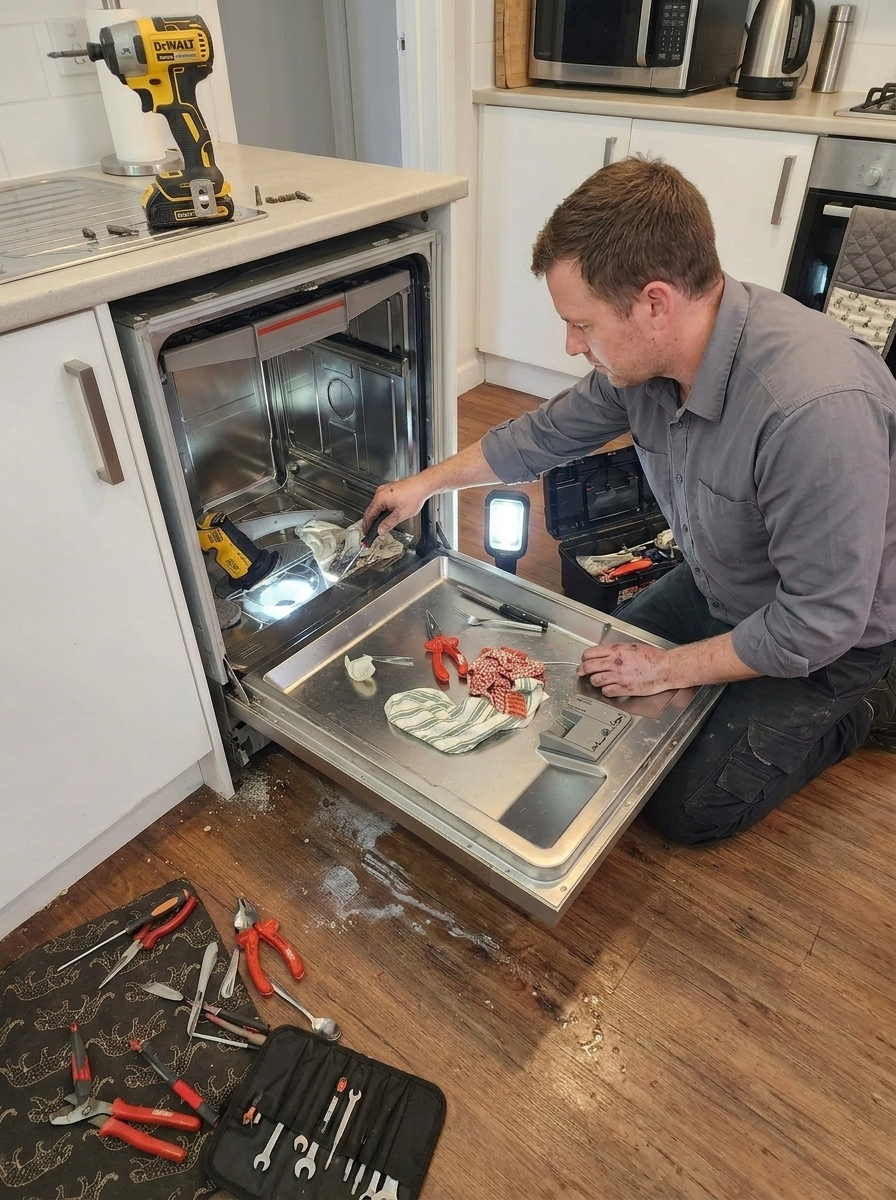
A small puddle in front of your dishwasher might not seem urgent. But even a slow leak can soak into subfloors, warp custom cabinetry, and create mold under your kitchen floor long before you see serious damage.
If your dishwasher is leaking, the key is finding the source quickly. In this guide, our Orange County appliance technicians explain what to do first, how to trace a leak, the most common causes, and when a leak needs professional repair.
What to Do Right Away
Before you start investigating, take these steps to limit damage:
- Stop the cycle and turn off the dishwasher.
- Switch off power at the circuit breaker.
- Shut off the water supply using the valve under the kitchen sink, usually on the hot water line.
- Remove standing water with towels and dry the floor completely.
- Check for water under nearby cabinets and along the toe kick.
If water has spread under the flooring, act quickly. The faster wet areas dry, the lower the risk of mold and warping.
Where Is the Water Coming From?
The location of the leak tells you a lot about the cause. Use this guide to narrow it down.
| Where you see water | Most likely causes |
| Dishwasher leaking from bottom of door | Door gasket, wrong detergent, door hinge, or unlevel dishwasher |
| Dishwasher leaking from bottom (under the unit) | Pump seal, hose connection, water inlet valve, or cracked tub |
| Dishwasher leaking from bottom left corner | Supply line, inlet valve, or drain hose connection |
| Water from the air gap on the sink | Clogged air gap or drain hose |
| Water only during draining | Drain hose, drain pump, or clogged drain |
| Water only during filling | Inlet valve, supply line, or float switch |
Tip: Dry everything thoroughly, then run a short cycle with the toe kick panel removed. Use a flashlight to watch underneath. This is often the fastest way to find the leak.
Why Is My Dishwasher Leaking? 9 Common Causes
1. Worn or Damaged Door Gasket
The rubber gasket around the door creates a watertight seal. Over time, it can crack, flatten, shrink, or collect food debris. When the seal breaks down, water escapes during the wash cycle and drips from the bottom of the door.
How to fix it: Inspect the gasket for gaps, tears, or buildup. Clean it with warm, soapy water. If it is damaged, replace it with the exact part for your model.
2. Using the Wrong Detergent
This is a surprisingly common cause of a dishwasher leaking from the bottom of the door. Regular liquid dish soap creates huge amounts of suds. Those suds push past the door seal and spill onto the floor.
Using too much dishwasher detergent, or certain rinse aids, can cause the same problem.
How to fix it: Use only dishwasher-specific detergent in the recommended amount. If suds are present, run a rinse cycle with a cup of white vinegar to break them down.
3. The Dishwasher Is Not Level
A dishwasher that tilts forward lets water pool against the door, where it can leak past the seal. This often happens after a new installation, flooring changes, or when the unit shifts over time.
How to fix it: Place a level on the bottom rack track and adjust the leveling legs until the dishwasher sits level front to back and side to side.
4. Overloading or Improper Loading
Large pans, cutting boards, or tall items can block the spray arm or deflect water directly at the door. Water then sprays past the gasket.
How to fix it: Load dishes according to your owner’s manual and make sure the spray arms spin freely before starting.
5. Loose or Damaged Water Supply Line
The water supply line connects your home’s plumbing to the dishwasher’s inlet valve. If the connection is loose, the fitting is corroded, or the line is cracked, water can drip during the fill cycle. This often shows up as a dishwasher leaking from the bottom left corner, where the supply connection is usually located.
6. Faulty Water Inlet Valve
The inlet valve opens and closes to let water into the dishwasher. A cracked valve body or a valve that does not close fully can leak water under the unit, even when the dishwasher is off.
7. Drain Hose Problems
The drain hose carries wastewater away from the dishwasher. A loose clamp, a cracked hose, or a clog that causes water to back up can all create leaks. A clogged drain system also makes the dishwasher hold water, which increases pressure on seals.
If your dishwasher is also holding standing water, see our guide on why your dishwasher is not draining.
8. Clogged Air Gap
The air gap is the small fitting mounted on your sink or countertop. When it clogs, drain water has nowhere to go and sprays out of the air gap onto your counter. A dishwasher air gap leaking is almost always a sign of a clog in the air gap itself or in the hose leading to the disposal.
How to fix it: Remove the cover and cap, clear out debris, and rinse. Then check the hose between the air gap and the disposal for clogs.
9. Pump Seal, Float Switch, or Tub Damage
Inside the dishwasher, the pump assembly uses seals that can wear out over time. A failed pump seal leaks water directly under the unit. A faulty float switch can let the dishwasher overfill, causing water to spill out. In rare cases, the tub itself can crack.
These repairs require disassembly and model-specific parts, and they are best handled by a technician.
Leaks and Premium Built-In Dishwashers
Many premium dishwashers, including Cove models, are fully integrated into custom cabinetry with panel-ready fronts. Some include a base pan or leak detection feature that stops the dishwasher when water is detected underneath.
If your dishwasher stops mid-cycle, refuses to start, or shows a warning after a leak, water may have collected in the base. The source must be found and repaired, and the base dried properly, before the dishwasher will run normally again. If your dishwasher’s controls are locked, see our guide on how to unlock a Cove dishwasher.
DIY Fixes vs. Professional Repair
Some leaks are easy to fix yourself, while others need a trained technician.
Good DIY fixes:
- Cleaning or replacing the door gasket
- Switching to the correct detergent
- Leveling the dishwasher
- Reloading dishes so spray arms move freely
- Clearing a clogged air gap
Call a professional for:
- Leaks under the dishwasher that you cannot trace
- Inlet valve, pump, or pump seal problems
- Supply line or plumbing connection leaks inside the cabinet
- Repeated leaks after DIY fixes
- Built-in or panel-ready dishwashers that must be removed from cabinetry
- Any leak that has damaged flooring or cabinets
Why a Leaking Dishwasher Should Not Wait
It is tempting to put a towel down and keep running the dishwasher. But dishwasher leaks almost always get worse. Water that escapes under the unit can go unnoticed for weeks, leading to swollen cabinet bases, warped hardwood floors, damaged subfloors, and mold growth.
In high-end Orange County kitchens with custom cabinetry and stone or wood floors, water damage repairs can cost far more than fixing the dishwasher itself.
How to Prevent Dishwasher Leaks
Prevention is mostly about simple habits and regular inspection. Use only dishwasher detergent, in the right amount. Clean the door gasket and filter every few weeks. Check under the sink every few months for drips at the supply line and drain hose. Keep the air gap and drain clear. Load dishes properly so they do not block spray arms. Finally, schedule service at the first sign of moisture.
A clean, well-maintained dishwasher also cleans better. Learn more in our guide on why your Cove dishwasher isn’t cleaning dishes properly.
Frequently Asked Questions
Why is my dishwasher leaking from the bottom? Common causes include a worn pump seal, a loose hose or supply line, a faulty inlet valve, or a cracked tub. Leaks at the bottom of the door are usually caused by the gasket, detergent suds, or an unlevel dishwasher.
Can I still use my dishwasher if it is leaking? It is not recommended. Continued use can cause hidden water damage to floors and cabinets.
Why is my dishwasher leaking from the bottom of the door? The door gasket may be worn or dirty, you may be using the wrong detergent, or the dishwasher may be tilted forward.
Is a leaking dishwasher worth repairing? For premium built-in dishwashers like Cove, repair is usually worthwhile. Most leaks are caused by replaceable parts.
How do I find where my dishwasher is leaking? Dry the area, remove the toe kick panel, and run a short cycle while watching underneath with a flashlight.
Stop the Leak Before It Becomes Water Damage
A dishwasher leaking water is your cue to act. Start with the easy fixes: check the gasket, detergent, level, and air gap. If the leak is under the unit or keeps coming back, a professional repair will protect your kitchen from costly damage.
Davis Subzero Repair specializes in Cove dishwasher repair for homeowners across Orange County, including Costa Mesa, Lake Forest, and San Juan Capistrano. Book your repair online or contact our team, and we will find and fix the leak fast.