
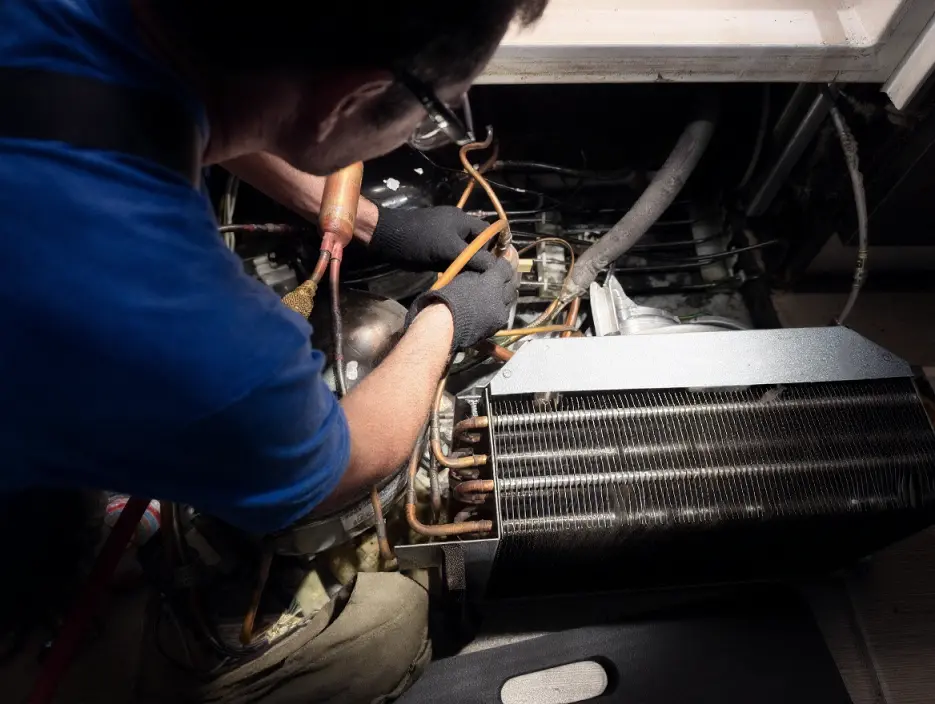
A Sub-Zero refrigerator is engineered for precise temperature control and long-term performance, but even a premium refrigeration system can develop problems. The good news is that many common Sub-Zero refrigerator problems show warning signs before they become major failures.
The most common issues include poor cooling, excessive frost, ice-maker failure, water leaks, food freezing in the refrigerator compartment, unusual noises, doors that do not seal properly, and refrigerators that run continuously. Dirty condenser areas, restricted airflow, worn door gaskets, temperature problems, blocked drains, and component failures can all contribute.
Sub-Zero itself recommends checking basics such as the temperature setting, door closure, door gasket condition, and condenser cleanliness before assuming a major cooling-system failure.
For homeowners looking for Sub-Zero refrigerator repair in Orange County, Davis Sub-Zero Appliance Repair provides diagnosis and repair for major Sub-Zero refrigerator models.
The Most Common Sub-Zero Refrigerator Problems at a Glance
| Problem | Common underlying causes | Prevention priority |
|---|---|---|
| Refrigerator not cooling | Dirty condenser, airflow restriction, fan, sensor, sealed-system problem | High |
| Refrigerator warm but freezer cold | Evaporator fan, defrost problem, airflow restriction, damper | High |
| Excess frost or ice | Door leak, defrost fault, blocked drain, moisture infiltration | High |
| Ice maker not producing ice | Freezer temperature, water supply, filter, frozen fill tube, ice-maker fault | Medium |
| Water leaking | Clogged drain, water valve/line, condensation, door-seal issue | High |
| Food freezing in refrigerator | Incorrect setting, sensor, airflow, control issue | Medium |
| Refrigerator runs constantly | Dirty condenser, warm room, poor seal, airflow or cooling-system issue | High |
| Loud or unusual noises | Fan, compressor, vibration, ice contacting components | Medium |
| Door does not close/seal | Damaged gasket, obstruction, alignment or hinge problem | High |
The important point is that a symptom does not automatically identify the failed part. For example, a warm refrigerator can result from a dirty condenser, evaporator fan problem, defrost issue, door gasket failure, temperature sensor problem, or sealed-system fault. Sub-Zero specifically notes that only qualified service can determine the exact cause of a cooling failure.
1. Sub-Zero Refrigerator Is Not Cooling Properly
A refrigerator that is warmer than expected is one of the most important Sub-Zero problems to address because temperature affects both food quality and food safety.
Start with the simplest checks:
- Confirm the refrigerator is actually powered on.
- Check the temperature setting.
- Make sure the doors close completely.
- Inspect the door gasket for tears, distortion, or gaps.
- Check whether food or shelving is obstructing the door.
- Inspect the condenser area and clean it if maintenance is overdue.
- Look for unusual frost accumulation or blocked airflow.
Sub-Zero commonly recommends approximately 38°F for the refrigerator and 0°F for the freezer, although exact settings and controls vary by model.
For food safety, the USDA recommends maintaining a refrigerator at 40°F or below and a freezer at 0°F or below. An appliance thermometer is more reliable than assuming the displayed setting represents the actual temperature throughout the compartment.
Why a dirty condenser matters
The condenser releases heat removed from the refrigerator. When dust and debris restrict airflow, the refrigeration system can struggle to reject heat efficiently. That can contribute to longer compressor run times, higher operating temperatures, and poor cooling performance.
Prevention: Make condenser inspection and cleaning part of your routine maintenance rather than waiting for a temperature alarm.
2. The Freezer Is Cold but the Refrigerator Is Warm
This symptom deserves special attention because it can point to an airflow problem rather than a complete cooling-system failure. The evaporator produces cold, while fans and air passages distribute that cooling where it is needed. If an evaporator fan stops working, frost blocks the evaporator, or an airflow path becomes restricted, the freezer may remain cold while the fresh-food compartment warms.
Repair guidance identifies several possible causes, including a defrost-system failure, evaporator fan problem, blocked airflow, door-seal problem, thermostat issue, or damper malfunction.
Prevention checklist
Keep packages from blocking vents, avoid packing the refrigerator so tightly that air cannot circulate, and investigate recurring frost rather than repeatedly removing the visible ice. If the refrigerator repeatedly warms while the freezer remains cold, professional diagnosis is preferable to replacing parts based on guesswork.
3. Excessive Frost or Ice Buildup
A small amount of frost during normal operation is different from heavy frost covering a back wall, evaporator area, or air passage.
Excessive frost can result when:
- Warm, humid air enters through a poor door seal.
- The defrost system does not remove accumulated frost.
- A defrost drain becomes blocked.
- Air circulation is impaired.
- A sensor or related control component fails.
Sub-Zero lists faulty door gaskets, air leaks, circulation problems, sealed-system issues, and clogged drain tubes among possible causes of frost or ice on the back wall.
How to prevent freezer frost
Do not leave the door open unnecessarily. Check that containers and shelves are not interfering with closure, and inspect the gasket periodically. If frost keeps returning after the obvious causes are corrected, the underlying defrost or drainage system should be diagnosed.
Avoid aggressively chipping ice from an evaporator or internal refrigeration component. A sharp tool can damage components that are far more expensive than the original frost problem.
4. Sub-Zero Ice Maker Is Not Making Ice
Ice-maker complaints are extremely common across refrigerators generally, and Sub-Zero’s own troubleshooting guidance identifies several possible causes.
A no-ice or low-ice condition can be related to:
- Freezer temperature being too warm
- Ice maker switched off
- Jammed ice cubes
- Frozen fill tube
- Water-supply problem
- Clogged water filter on models equipped with one
- Improperly seated ice bin
- Water inlet or ice-maker component failure
Sub-Zero recommends a freezer setting around 0°F and notes that ice production can be affected when freezer temperature rises above approximately 5°F. After certain corrections or a reset, it can take up to 24 hours to see normal ice production.
Prevention
Do not ignore gradually declining ice production. A refrigerator that goes from full ice production to occasional small or hollow cubes may be signaling a water-flow, temperature, or component problem.
If your model uses a water filter, replace it according to the manufacturer’s instructions rather than waiting until water or ice production stops completely.
5. Water Leaking From or Under the Refrigerator
A puddle around a built-in refrigerator should not automatically be blamed on the ice maker.
Possible sources include:
- Clogged defrost drain
- Water inlet or supply-line problem
- Ice-maker water issue
- Door-seal problem
- Drainage problem
- Condensation associated with abnormal airflow or temperature
A blocked defrost drain can allow water generated during the defrost process to accumulate where it should not.
A useful diagnostic clue
Water inside the refrigerator and water appearing on the floor can have different causes. Note exactly where the water first appears, rather than only where it eventually pools.
If water is reaching electrical components, flooring, cabinetry, or nearby walls, shut the appliance down if appropriate and arrange professional service promptly.
6. Food Is Freezing Inside the Refrigerator
A Sub-Zero refrigerator should keep food cold without unnecessarily freezing fresh-food items. If lettuce, beverages, milk, or other foods are freezing, first check the temperature setting and product placement. Sub-Zero recommends checking the temperature controls and condenser cleanliness when food freezes unexpectedly.
Potential mechanical or electronic causes include a faulty temperature sensor, thermostat, control component, or excessive airflow in a particular area.
Prevention tip
Do not immediately compensate by setting the refrigerator warmer and warmer. If freezing continues despite an appropriate setting, the problem may be related to temperature sensing or airflow. Use an appliance thermometer to determine what the compartment is actually reaching.
7. The Refrigerator Runs Constantly
A Sub-Zero refrigerator does not necessarily have a problem simply because you hear the compressor running frequently. Refrigeration systems may run longer during periods of heavy use, warm ambient temperatures, or after loading the refrigerator with groceries.
However, continuous operation accompanied by poor cooling, frost, unusual noise, or temperature instability deserves investigation.
Common possibilities include:
- Dirty condenser
- Warm surrounding environment
- Door not sealing
- Frost restricting airflow
- Fan problem
- Cooling-system problem
- Compressor or control issue
Repair guidance notes that a hot environment, inadequate freezer temperature, door problems, defrost faults, and compressor issues can all contribute to continuous operation.
Prevention strategy
Think of condenser maintenance and door-seal maintenance as two basic defenses against unnecessary refrigeration-system stress.
8. Unusual Buzzing, Clicking, Grinding, or Humming
Some refrigerator sounds are normal. Compressors, fans, refrigerant flow, ice production, and automatic defrost cycles can all create operating noises.
The concern is a new, persistent, or progressively worsening sound.
For example:
- A grinding sound may point toward a fan or bearing problem.
- Repetitive clicking may occur when a component is attempting to start.
- Buzzing can be associated with fans, valves, or electrical components.
- A vibration may come from the refrigerator contacting cabinetry or another surface.
Do not diagnose a compressor failure based on sound alone. A technician can compare the sound with operating conditions and determine whether the source is mechanical, electrical, airflow-related, or part of normal operation.
9. Door Gasket Problems and Poor Sealing
A refrigerator door gasket is a deceptively important component. Its job is to maintain a tight barrier between conditioned interior air and the warmer room environment. When the gasket is torn, warped, compressed, dirty, or prevented from contacting the cabinet correctly, warm humid air can enter.
That can create a chain reaction:
Poor gasket seal → warm-air infiltration → condensation/frost → restricted airflow → reduced cooling performance → longer operating cycles.
This relationship is why replacing a worn gasket is not merely cosmetic maintenance. Sub-Zero specifically recommends inspecting the gasket when temperature or frost problems occur.
Protect Your Refrigerator—and the Food Inside It
The refrigerator itself is only part of the equation. A cooling problem can become a food-safety problem if the internal temperature remains too high.
The USDA advises keeping refrigerators at 40°F or below and freezers at 0°F or below. It also recommends using an appliance thermometer because refrigerator controls do not always tell you the actual compartment temperature.
If a refrigerator loses power, the USDA says an unopened refrigerator generally keeps food safe for about four hours; perishable foods that have been above 40°F for more than two hours should generally be discarded.
That makes early attention to temperature problems worthwhile—not simply because repairs can become more expensive, but because the refrigerator’s primary job is protecting perishable food.
FAQs
What is the most common problem with a Sub-Zero refrigerator?
Cooling problems are among the most common complaints. Possible causes include condenser airflow restrictions, door-seal problems, fans, defrost faults, temperature sensors, controls, or sealed-system issues. The symptom alone does not identify the failed component.
Why is my Sub-Zero refrigerator not cooling but the freezer is cold?
A cold freezer with a warm refrigerator compartment can indicate restricted airflow, an evaporator fan problem, frost buildup, a damper issue, or another temperature-control problem.
How often should a Sub-Zero condenser be cleaned?
The appropriate interval depends on the model and environment. Sub-Zero troubleshooting guidance commonly recommends checking or cleaning the condenser when cooling problems occur and references a six-month interval in several troubleshooting instructions.
Why does my Sub-Zero refrigerator keep forming ice?
Recurring ice can result from warm-air infiltration through a poor gasket, blocked airflow, a clogged drain, or a malfunctioning defrost system. If frost repeatedly returns after basic checks, the underlying cause should be diagnosed.
Why is my Sub-Zero ice maker not making ice?
Check that the ice maker is switched on, the freezer is sufficiently cold, the water supply is available, and the ice bin and fill tube are unobstructed. A clogged filter or component failure can also affect ice production.
What temperature should a Sub-Zero refrigerator be?
Sub-Zero commonly recommends approximately 38°F for the refrigerator and 0°F for the freezer, depending on model. From a food-safety standpoint, the USDA recommends keeping the refrigerator at 40°F or below and the freezer at 0°F or below.
Is it worth repairing an older Sub-Zero refrigerator?
Often, yes, particularly when the problem involves a serviceable component rather than a major sealed-system failure. The decision should consider the refrigerator’s age, condition, repair diagnosis, parts availability, and estimated repair cost rather than age alone.
When should I call a professional for Sub-Zero refrigerator repair?
Call a qualified technician when cooling problems persist after basic checks, frost repeatedly returns, water leaks continue, electrical components are involved, or the suspected problem involves the compressor, sealed refrigeration system, control board, evaporator, or other internal components.